A Complex Adaptive System (CAS) is a system composed of many interacting agents, whether organisms, individuals, organisations, or computational entities, that adapt their behaviour in response to each other and to their shared environment, and whose collective interactions produce emergent patterns and structures that no single agent designed or controls.
The concept was developed and formalised at the Santa Fe Institute, principally by John Holland, Murray Gell-Mann, and their colleagues, drawing on analogies between biological evolution, immunology, neural learning, and economic markets. The intellectual ambition was significant: to identify a common framework capable of describing the self-organising, adaptive, emergent dynamics found across wildly different empirical domains. That ambition has proven remarkably productive.
What distinguishes a CAS from a merely complicated system is not the number of components but the nature of their interactions. A complicated system, such as a mechanical clock, a conventional supply chain model, or a spreadsheet, can in principle be fully understood by analysing its parts and their fixed relationships. A CAS cannot, because the behaviour of agents is not fixed: it evolves in response to feedback, and the patterns that emerge from those interactions feed back to alter future agent behaviour in ways that are not specified in advance.
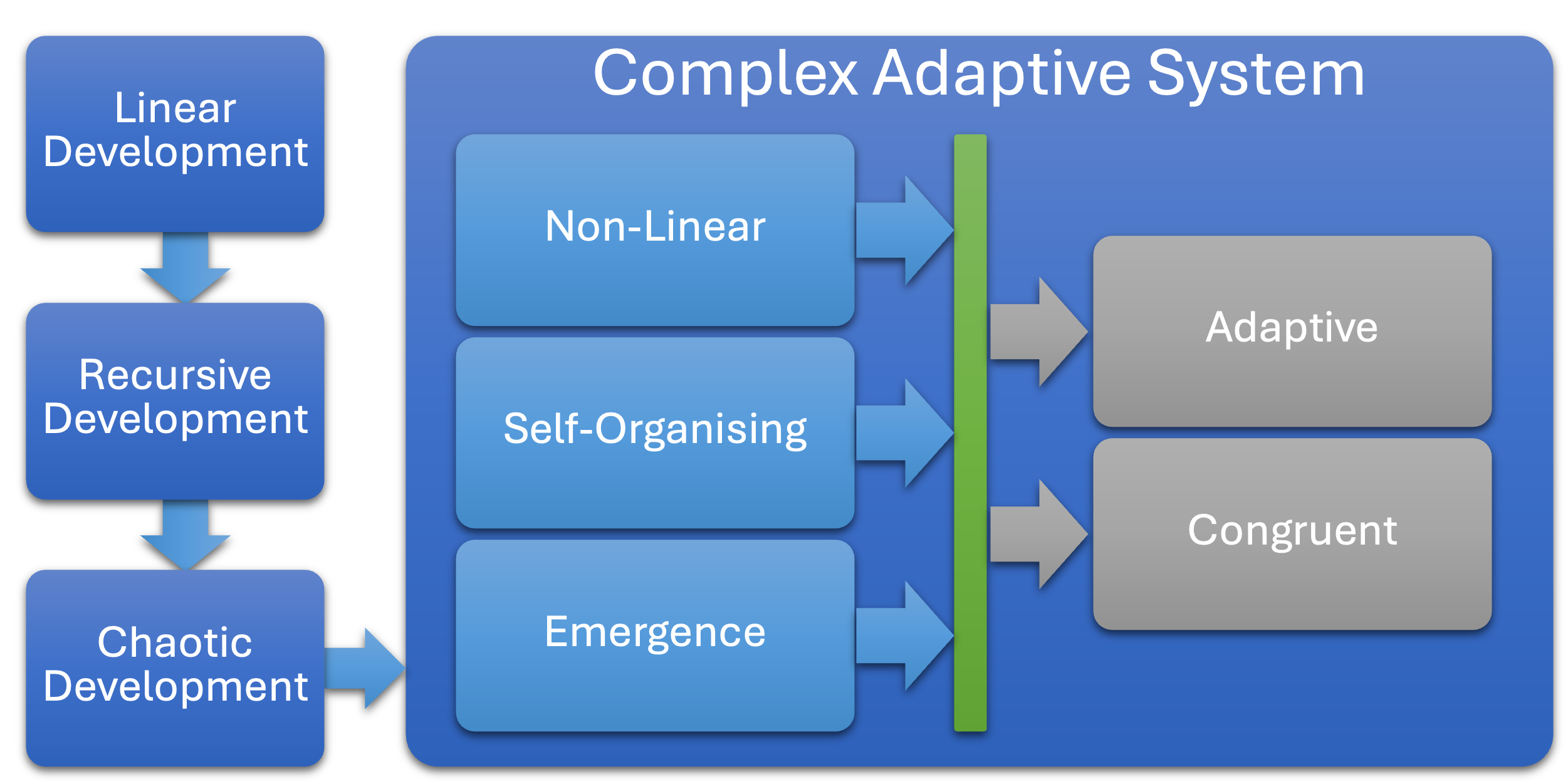
Key Characteristics
Emergence
The global behaviour of a CAS arises from local interactions between agents and cannot be predicted or fully explained by examining those agents in isolation. This is not merely an epistemological claim about the limits of our knowledge; it is an ontological claim about the structure of the system. The patterns exist at the level of the whole, not the part. Traffic jams, financial bubbles, the coordinated foraging of ant colonies, the collective intelligence of markets, the cultural norms of organisations: all are emergent.
Adaptation and Learning
Agents within a CAS modify their behaviour on the basis of experience and feedback. This adaptive capacity operates at multiple levels simultaneously: individual agents learn, populations of strategies evolve through selection, and the system as a whole may develop new capacities for response. Crucially, adaptation is not optimisation: agents are not computing globally optimal strategies. They are operating with local information, bounded rationality, and simple heuristics, and yet the collective outcome is often impressively functional.
Self-Organisation
Order and structure arise in a CAS without being imposed from outside. There is no central planner, no architect, no programme being executed. Local interaction rules give rise spontaneously to global patterns. This is perhaps the most counterintuitive feature of complex systems for those trained in traditional management or engineering: the idea that coherent, functional structure can be the product not of design but of process.
Nonlinearity
Relationships between agents, and between agents and their environment, are nonlinear. This means that the effects of actions are context-dependent, history-dependent, and often disproportionate. Small perturbations can cascade into large systemic effects; large interventions can dissipate without trace. This makes complex systems intrinsically difficult to manage through conventional command-and-control approaches, which assume roughly linear relationships between policy levers and outcomes.
Diversity of Agents
A CAS contains agents that differ from each other in their strategies, resources, perceptions, and decision rules. This heterogeneity is not noise to be averaged out; it is a functional property of the system. Diversity drives exploration of the solution space, enables different agents to occupy different niches, and makes the system as a whole more robust to perturbation. Homogeneous systems, i.e., those in which all agents behave alike, are typically more fragile.
Decentralised Control
There is no centre of authority in a CAS. Control is distributed across the agents and emerges from their interactions. This has practical consequences that are easily underestimated: interventions that assume a chain of command, i.e., that a policy directive will translate cleanly into changed behaviour across the system, routinely fail in CAS environments. Influence propagates through the system in complex, indirect, and often counterintuitive ways.
Co-evolution
Agents in a CAS do not adapt to a stable environment; they adapt to an environment that is itself being reshaped by other adapting agents. The fitness landscape is not fixed; it shifts as agents move across it. This co-evolutionary dynamic is the source of much of the perpetual novelty, disruption, and instability characteristic of complex systems. It also means that strategies which are optimal today may be actively disadvantageous tomorrow.
Far-from-Equilibrium Dynamics
CAS typically operate far from thermodynamic equilibrium, sustained by continuous flows of energy, information, and resources. They are not converging to a rest state; they are maintaining their structure through continuous throughput. This is what makes them living, adaptive, and capable of evolution, and also what makes them inherently unstable over long time horizons.
CAS Across Domains
Biology
The immune system is perhaps the most studied CAS. Billions of cells with no central coordination produce a remarkably specific and adaptive response to pathogens, while simultaneously maintaining tolerance of the body’s own tissues. The ecosystem, with its webs of predation, competition, mutualism, and decomposition, is another canonical example, exhibiting emergent properties such as nutrient cycling, population oscillations, and succession dynamics. Neural networks in the brain give rise to cognition, consciousness, and creativity in ways that remain among the deepest puzzles of science.
Social and Economy
Financial markets exhibit CAS dynamics that standard equilibrium models persistently fail to capture: the formation and collapse of bubbles, the sudden emergence of systemic risk, the co-evolution of trading strategies. Cities are striking examples; they self-organise into patterns of land use, traffic, economic activity, and cultural geography through the uncoordinated interactions of millions of individuals, and they display scaling laws (population density, economic output, patent rates) that are remarkably consistent across time and geography. The internet itself is a CAS: its topology, its patterns of information flow, and its emergent social norms arise from the local decisions of billions of users and no central authority.
Organisations and Management
Firms are embedded within larger business ecosystems, i.e., networks of customers, suppliers, partners, competitors, and regulators that co-evolve in response to market signals and each other’s strategies. Platform businesses such as Apple’s App Store, Amazon’s marketplace, and Alibaba’s ecosystem are explicit attempts to harness CAS dynamics: to create conditions under which complementary agents self-organise to create value that the platform orchestrator could not generate alone.
Technology
artificial intelligence systems, particularly large language models and deep neural networks, increasingly display properties characteristic of CAS. They exhibit emergent capabilities that their architects did not design and cannot fully explain: sudden transitions in performance as scale increases, the appearance of reasoning capacities from training on prediction tasks, and the spontaneous formation of internal representations. Understanding AI through a complexity lens is one of the most productive and urgent research frontiers of the 2020s.
CAS in Strategic Management
The implications of the CAS framework for strategic management are profound and, in many respects, still being worked through. They challenge some of the most deeply held assumptions of conventional strategy.
From Planning to Enabling
If organisational outcomes emerge from complex interactions among agents rather than from the execution of a predetermined plan, the role of leadership shifts from directing to enabling. The task is not to design the optimal strategy and impose it, but to cultivate the conditions, i.e., the rules of interaction, the flows of information, the diversity of approaches, from which effective strategy can emerge. This is sometimes called generative leadership or complexity leadership theory.
Fitness Landscapes and Strategic Positioning
W. Brian Arthur and Stuart Kauffman’s work on fitness landscapes provides a powerful metaphor for strategic thinking in CAS environments. Firms search for positions of high fitness in a landscape that is continuously shifting as competitors, customers, and technologies evolve. Near the edge of chaos, at the boundary between rigid order and formless disorder, adaptive search is most productive. Too much order and the system cannot explore; too much disorder and it cannot exploit what it has found.
Resilience Over Optimisation
In a CAS environment characterised by novelty, disruption, and fat-tailed risk distributions, the pursuit of efficiency optimisation is frequently a trap. Optimised systems are typically brittle: they have eliminated redundancy and diversity in the service of efficiency, and are therefore vulnerable to perturbations outside the range for which they were optimised. Resilient systems maintain enough slack, diversity, and adaptive capacity to absorb shocks and reconstitute themselves. The strategic imperative in CAS environments is not to be optimally efficient today but to be adaptively resilient across a range of possible tomorrows.
Signalling and Boundary Management
A crucial and often neglected dimension of managing within a CAS is the management of information flows: what signals agents receive, how boundaries between subsystems are defined, and how feedback travels through the system. Organisations that invest in rich, timely, and distributed information flows tend to adapt more successfully than those in which information is hoarded or filtered through hierarchical chains of command.
Co-evolutionary Strategy
Because the business environment is itself shaped by the strategies of all its participants, competitive strategy cannot be developed in isolation. The concept of co-evolution requires firms to think not merely about what is the best response to current conditions, but about how their strategic choices will alter those conditions and provoke responses that will alter the landscape further. This requires a dynamic, iterative, scenario-aware mode of strategic reasoning that differs markedly from the static positioning logic of classical competitive strategy.